Thursday, November 15, 2007

The Song Of The Sybil Voluspa

The Song Of The Sybil Voluspa Cover

Book: The Song Of The Sybil Voluspa by Wh Auden

Voluspa (Prophecy of the Volva) is the first and best known poem of the Poetic Edda. It tells the story of the creation of the world and its coming end related by a volva addressing Odin. It is one of the most important primary sources for the study of Norse mythology.

The poem is preserved whole in the Codex Regius and Hauksbok manuscripts while parts of it are quoted in the Prose Edda. It consists of approximately 60 fornyrdislag stanzas.

Voluspa is found in the Codex Regius Manuscript (ca. 1270) and in Haukr Erlendsson's Hauksbok Codex (ca. 1334), and many of its stanzas are quoted or paraphrased in Snorri Sturluson's Prose Edda (composed ca. 1220, oldest extant manuscript dates from ca. 1300). The order and number of the stanzas varies in these sources. Some editors and translators have further rearranged the material. The Codex Regius version is usually taken as a base for editions.

The poem starts with the volva requesting silence from "the sons of Heimdallr" (human beings) and asking Odin whether he wants her to recite ancient lore. She says she remembers giants born in antiquity who reared her.

She then goes on to relate a creation myth; the world was empty until the sons of Burr lifted the earth out of the sea. The AEsir then established order in the cosmos by finding places for the sun, the moon and the stars, thereby starting the cycle of day and night. A golden age ensued where the AEsir had plenty of gold and happily constructed temples and made tools. But then three mighty giant maidens came from Jotunheimar and the golden age came to an end. The AEsir then created the dwarves, of whom Motsognir and Durinn are the mightiest.

At this point ten of the poem's stanzas are over and six stanzas ensue which contain names of dwarves. This section, sometimes called Dvergatal (catalogue of dwarves), is usually considered an interpolation and sometimes omitted by editors and translators.

After the Dvergatal, the creation of the first man and woman are recounted and Yggdrasill, the world-tree, is described. The seer recalls the events that led to the first ever war, and what occurred in the struggle between the AEsir and Vanir.

The seeress then reveals to Odin that she knows some of his own secrets, of what he sacrificed of himself in pursuit of knowledge. She tells him she knows where his eye is hidden and how he gave it up in exchange for knowledge. She asks him in several refrains if he understands, or if he would like to hear more.

The seeress goes on to describe the slaying of Baldr, best and fairest of the gods and the enmity of Loki, and of others. Then she prophesies the destruction of the gods where fire and flood overwhelm heaven and earth as the gods fight their final battles with their enemies. This is the "fate of the gods" - Ragnarok. She describes the summons to battle, the deaths of many of the gods and how Odin, himself, is slain.

Finally a Beautiful reborn world will rise from the ashes of death and destruction where Baldr will live again in a new world where the earth sprouts abundance without sowing seed. A final stanza describes the sudden appearance of Nidhogg the dragon, bearing corpses in his wings, before the seeress emerges from her trance.

Download Wh Auden's eBook: The Song Of The Sybil Voluspa

Books in PDF format to read:

Max Heindel - The Message Of The Stars
Aleister Crowley - The Book Of The Law
Horace Wallis - The Cosmology Of The Rigveda
Benjamin Rowe - The Book Of The Seniors
Wh Auden - The Song Of The Sybil Voluspa

Wednesday, November 7, 2007

Magic And Wyrd

Magic And Wyrd Cover

Book: Magic And Wyrd by Anonymous

Wyrd is the underlying fabric in the Northern/Germanic cosmology. The laws of Wyrd supercede the will of the Gods, of men and all creatures. Wyrd provides the basic structure for the Nine Worlds, and manifests itself in Yggdrasil and the Well of Urdr.

One can compare Wyrd to a song, there are many differnt ways to sing it but the basic tune remains the same. Wyrd is also Frequently seen as weaving, different threads coming Together on a framework to make a pattern.

Magic is one of the ways we interact with Wyrd. "Knowing" magic (in Manny Olds' words) or "predictive" magic (Groa's) is about becoming aware of the patterns in Wyrd and the disposal of individual strands in the tapestry. Spae-work and Rune-work are two of the Techniques which can be used for this.

Download Anonymous's eBook: Magic And Wyrd

Books in PDF format to read:

Naomi Janowitz - Magic In The Roman World
Carroll Runyon - Magick And Hypnosis
George Moir - Magic And Witchcraft
Anonymous - Magic And Wyrd

Gods And Goddesses Of Odinism

Gods And Goddesses Of Odinism Cover The Gods and Goddesses of Odinism belong to two 'groups` or 'families` of beings called the Aesir and the Vanir. On a very basic level the Aesir can be said to govern and mould the 'intellectual` aspects and the Vanir are more Earth based.
However this is very much an over simplification but this is not the place for detailed analysis. It is these divine beings (together with other entities) which have moulded us, our link with them is spiritual and biological. Again, the understanding and experience of the Gods is multi layered, suffice to say that whatever the stage of an individuals personal evolution, they can access the Gods of our folk in a meaningful way.

Like all complete religions, Odinism has its mythology. Myths are not to be understood as expressing literal truths or events, but as a way primal realities may be expressed. They explain deep realities and wisdom of creation in ways that we may understand. Far from being the fanciful tales of an ignorant people, the mythology of Odinism Together With Other Odinic teachings shows a very sophisticated, complex and profound knowledge of reality and existence. Odinism can be seen as an outward expression of the forces of creation and as a Spiritual Path ideally suited to our folk as a unique folk family. Odinsm and the Odinic impulse, the Odin consciousness in reality has never left us, but the conscious awareness was suppressed. Now we have seen a re-awakening, an overt awareness of our unique spiritual way. The Odinic Rite has been and is at the very forefront of the Odinic renewal. It must be realised that no written article, no information garnered from books or web sites can fully explain Odinsm, it is not just a thing to understand intellectually, but an experienced path with depths beyond mere words.

Odinism is a living religion, a combination of cultural, material, ethical and spiritual realities as they relate to our folk family and our place in creation. It evolves, as we evolve, we evolve, as it evolves.

For those who are interested in consciously re-establishing their link with their natural religion and spirituality, for those interested in following a path to the illumination of the Odin Consciousness. For those anxious to reclaim their unique heritage and play their role in heralding a golden future, we invite you to join the Odinic Rite.

Hail the New Awakening, May Odins Light Illuminate You.

Books in PDF format to read:

Joseph John William - Voodoos And Obeahs Phases Of West India Witchcraft
Miac - Asatru And Odinism
Michael Jordan - Dictionary Of Gods And Goddesses

Saturday, November 3, 2007

The Birth Of God Vali

The Birth Of God Vali Cover The Prophecy made by Rossthiof was duly fulfilled, for Rinda bore a son named Vali (Ali, Bous, or Beav), a personification of the lengthening days, who grew with such marvelous rapidity, that in the course of a single day he attained his full stature. Without even taking time to wash his face or comb his hair, this young God hastened off to Asgard with bow and arrow to avenge the death of Balder, God of light, by slaying his murderer, Hodur, the blind God of darkness.

“But, see! th’ avenger, Vali, come,
Sprung from the west, in Rindas’ womb,
True son of Odin! one day’s birth!
He shall not stop nor stay on earth
His locks to comb, his hands to lave,
His frame to rest, should rest it crave,
Until his mission be complete,
And Baldur’s death find vengeance meet.”
-VALHALLA (J. C. Jones)

In this tale, Rinda, a personification of the hard-frozen rind of the earth, resists the warm wooing of the sun, Odin, who vainly points out that spring is the time for warlike exploits, and offers the adornments of golden summer. She only yields when, after a shower (the footbath), a thaw set in. Conquered then by the sun’s irresistible might, the earth yields to his embrace, is freed from the spell (ice) which made her hard and cold, and brings forth Vali the nourisher, or Bous the peasant, who emerges from his dark hut when the pleasant days have come. The slaying of Hodur by Vali is therefore emblematical of “the breaking forth of new light after wintry darkness.”

Vali, who ranked as one of the twelve deities occupying seats in the great hall of Gladsheim, shared with his father the dwelling called Valaskialf, and was destined, even before birth, to survive the last battle and Twilight of the Gods, and to reign with Vidar over the regenerated earth.

:

Marion Crawford - The Witch Of Prague
Ea Wallis Budge - The Book Of Gates Vol Ii
Israel Regardie - The Art Of True Healing
John Musick - The Witch Of Salem

Wednesday, October 17, 2007

The History Of Asatru Kindreds In Vinland

The History Of Asatru Kindreds In Vinland Cover The first kindreds were formed in Vinland in the early 70's. The Asatru Free Assembly strived to found Kindreds at this time, and while the Odinist Fellowship did not, members of the Fellowship formed Kindreds all the same. There were also a few independent Kindreds that were already in existence at this time and some of them later joined both the AFA and the OF. When both of these pioneering groups disbanded, it was the Kindreds of these former groups that vowed to learn from the lessons of the past and form the Asatru Alliance. The number one lesson to be learned is that national organizations are certainly necessary and do much to promote the growth of our religion, but they are subject to failure and disbandment. All the while, the Kindreds survive!

Of the many Kindreds that were formed in the late 60's and 70's only two survive: Arizona Kindred and Wulfing Kindred. Although it is estimated that there are about 100 Kindreds in Vinland today, how many of THESE will be around in a few short years? Only those with an iron will, boundless courage, and clear and level head will survive and prosper.

Free eBooks (Can Be Downloaded):

Arthur Edward Waite - The Real History Of The Rosicrucians Part Iii
Arthur Edward Waite - The Real History Of The Rosicrucians Part Iv
Joseph Ennemoser - The History Of Magic Vol 2
Julia Phillips - History Of Wicca In England

Tuesday, October 9, 2007

The Spirit Of Odin

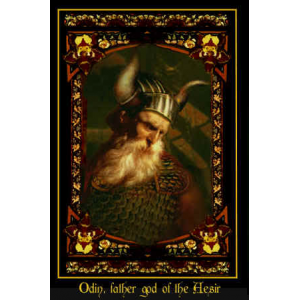
The Spirit Of Odin Cover WE regard Odin as the most important of our gods. For this reason, whatever one thinks of when meditating or pondering on the Gods and Goddesses and their differing powers, each aspect of that power is part of the great Allfather.

What is peculiar and interesting about Odin is that he is one and many. He is like the mind itself, in which there can be dark thoughts and light thoughts and thoughts toward war as toward peace. There can be those of creative art and there can be the negative attributes of chaos and destruction. All these, are reflections of the human mind, counterbalanced by ideas on one side of positive idealism and on the other by negative idealism.

Man is not separate from his gods for he is in divine link through blood, spirit and being. Surely this must be a more realistic picture of a force which is at the back of creation. All these elements are bound together in proportion within a spiritual force which plans and orders things. Odin comes close to being how things really are.

The most satisfactory way to approach a god of the spirit is to go on the path towards spirit: to love the use of the word, to love music, to love anything which is inspired. If we in our lives can share some of this then we shall surely know Odin. When we do something well, when we write well, talk well, even fight well, whatever we do that has passion and is inspired, it has the handiwork of Odin in it. Planning, skill, craft and mind power, in all this we can know him, for he represents that point of light that all creation comes from, for he is the Oddr. If, therefore, one wishes to know Odin then the need is to discover what is without, what is outside in life, on the land, in the wood or the brook, in space and beyond, for it is also within. The power that comes from the oddr is deep within and in the greater aspect of the folk soul. All have that innate spark, the ability to commune with the point of creation. What then of the Christian god?

The Eastern concept is that one and all must humbly submit and cower before a supreme and ultimate will in fear or be damned in defiance. One must follow in blind faith and without question, be one of a flock of sheep, to regard a god as the beneficial shepherd. But Odin, god of the North, does not want spiritual slaves. He is for heroes, for the doers of deeds and of actions. O3in's folk stand proud and noble, without mental chains. He shuns those who skulk and those who would plead f or divine favour. Because he is leader among the gods he expects men and women to be great, to model themselves upon the Odinic archetype and live by example. This at the end of the day can only be done through the use of gifts which are beyond the rational, beyond logical procedure, whereby it involves the senses of the deeper unconscious levels of the mind, that which is just as real, just as vital as everyday events that happen and occur in the mind.

Odin is able to stir these deep ancient waters and to move people. But ultimately action rests with the individual. Upon the ship of life one can sail well, steer it straight and in the right direction, knowing that the god of our folk is always there. From out of the past, into the present and forward toward the future the Oddr, the high god Odin Allfather will always be, for he has always been.

Free eBooks (Can Be Downloaded):

Aubrey Bell - The Magic Of Spain
Yacki Raizizun - The Secret Of Dreams
Starhwak - The Spiral Dance
Irv Slauson - The Religion Of Odin

Saturday, October 6, 2007

Nordic Pagans In The United States

Nordic Pagans In The United States Cover When Nordic Pagans in the United States speak of their European origins or ancestors, there is a certain ambiguity in terms of what Nordic Paganism is, where it came from, and whom it is for. It is common for Nordic Pagans to describe Asatru or Heathenry in very broad and general terms as being the religious Expression of the cultural heritage of “Northern European” peoples or even, as in the Runestone passage noted earlier, of “European-descended” peoples. Considering the diversity of nations and language groups that have existed in Europe and even Northern Europe from ancient times to the present, the lack of precision about which particular linguistic or cultural group the modern religion is derived from or related to is striking. There seems to be a tendency among many Nordic Pagans to “essentialize” Northern Europe and sometimes Europe in general as the “land of our ancestors,” without actually explaining which ancestors in which land, speaking which language, and so forth. As most Nordic Pagans center their religion on the worship of Odin, Thor, and other gods found in the Old Norse–Icelandic literature, what seems to be occurring is a use of the religious heritage of one particular part of Northern Europe as a convenient, shorthand way of respecting the collective religious heritage of a more diverse set of past peoples and cultures, that of pre-Christian Northern Europe or even Europe in general. The general vagueness of American Nordic Pagan views of the Northern European “homeland” is a poignant Commentary on the distance that divides American Heathens and Asatru followers from the lands of their spiritual ancestors, but it also helps to mediate conflicting definitions of Nordic heritage and divergent loyalties toward different specific regions of Northern Europe.

However, it should be noted that some Nordic Pagans are highly knowledgeable and articulate about the regional varieties of ancient Northern European culture and religion and travel to meet with their Pagan compatriots in Iceland and other nations. Those Heathens and Asatruar who acquire substantial knowledge of the texts, traditions, and languages of the various peoples of pre-Christian Northern Europe are greatly respected in their communities, and they often publish articles in Asatru or Heathen magazines as well as compete in lore contests at Things and other important occasions.

Free eBooks (Can Be Downloaded):

Troth Aor - Odinism What Is It The Odinic Rite
Aleister Crowley - The Zodiac And The Tarot
Hargrave Jennings - The Rosicrucians Their Rites And Mysteries