Sunday, January 29, 2006

God Odin

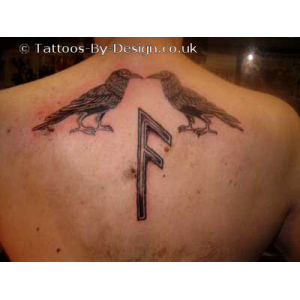
God Odin Cover Odin, also known as the Allfather, was involved in the creation of the universe and humanity. His chief Weapons are the spear and his deep
knowledge. A strong seeker of wisdom, he has sacrificed an eye for Greater knowledge, leaving him with only one eye. His quests have brought humanity the Runes and the Mead of Inspiration.

Odin is the most ephemeral and intangible of sky gods, the god of the windy sky. Whereas Thor is the transient and violent sky god of the thunder-flash. But Tyr - for Dieus also implies radiance or brilliance - is the god of the bright clear day sky. Just like the sky, Tyr is always there, constant and reliable like a father.

Free eBooks (Can Be Downloaded):

Ross Arthur - English Old Norse Dictionary
Miac - Asatru And Odinism
Irv Slauson - The Religion Of Odin
Morwyn - The Golden Dawn

Friday, January 27, 2006

Asatru Poem First Act

Asatru Poem First Act Cover Beyond the Dawn, of Godkind's Walk
Through all Nine Worlds, and Mankind's Heart
Lay awaiting, All Things, No Thing
Ginungagap, the Well unfilled

In this Placeness, what could be found
To Call to Life, The Everything
To bring about, The Beingness
Ginungagap, the Well unfilled

Without Being, can be no Deed
And without Deed, is no Orlay
To lack Orlay, is to lack Wyrd
Ginungagap, the Well unfilled

Within the Dream, beyond All Dream
Something did stir, Shifting, Pulsing
Forces livened, from Where, Unknown
Ginungagap, the Well filling

From Isa's breath, the hoar frost grew
And formless Void, was brought to Shape
Primal layers, growing, silent
Ginungagap, the Well filling

Kenaz did dance, in glowing spark
And quickened Things, along their way
Brought Action to the Static growth
Ginungagap, the Well filling

Thus Perthro's womb, took needful Form
Within, Around, Becomingness
And Life did come, both Rude and Right
Ginungagap, the Well full filled

Free eBooks (Can Be Downloaded):

Allen Greenfield - A True History Of Witchcraft
Tuesday Lobsang Rampa - Wisdom Of The Ancients
Daniel Defoe - A System Of Magic
Reeves Hall - Asatru In Brief

Wednesday, January 25, 2006

Group That Worships Norse Gods To Become Officially Accepted Religious Community

Group That Worships Norse Gods To Become Officially Accepted Religious Community Cover Home to the Vikings of yore, Denmark said Wednesday it will let a group that worships Thor, Odin and other Norse gods conduct legally-recognized marriages.

"To me, it would be wrong if the indigenous religion of this country wasn't recognized," Tove Fergo, the minister for Ecclesiastic Affairs and a Lutheran priest, told The Associated Press.

Under Danish law, the state Evangelical Lutheran Church has sole authority to recognize other religious communities.

The 240-member Forn Sidr, which worships Odin, Thor, Freya and the other members of the Norse pantheon, sought recognition in 1999, said Tissel Jacobsen, the group's president.

Last year, an Ecclesiastic Affairs panel of scholars recommended that Forn Sidr, whose name mean "Old Custom" in old Norse, be approved, but only if their rituals were clearly detailed in its bylaws.

"At a general assembly, we added and described our four annual heathen rituals -- spring and fall equinoxes, and the summer and winter solstices, and our marriage ceremony," Jacobsen told the AP. "We then returned our application and the panel approved it."

Fergo said she would give her final approval "in a few days."

About 1,000 people worship the ancient gods in Denmark, Jacobsen said.

Since 1998, the panel of theology, law and history scholars have advised the government on which groups seeking to become religious communities, should be recognized.

"It was not up to me to evaluate whether they are telling the truth or the quality of their religion," Fergo said. "Based on the commission's evaluation and what I have read, I consider it a good religion."

Officially recognized religious communities can marry people and exempt their members from the 1 percent income tax that is imposed on members of the state church.

People born in Denmark are automatically made members of the state church, but can choose to leave it if they want. Members of other recognized religious communities, such Catholics, Muslims and Jews, are also exempt from the tax.

Free eBooks (Can Be Downloaded):

The Troth - Introduction To The Runes Some Frequently Asked Questions
The Troth - Heathen Gods And Rites Some Frequently Asked Questions
Ellen Friedman - As Above So Below A System Of Value Based Ethics For Wiccan Clergy
Sir James George Frazer - The Golden Bough A Study Of Magic And Religion

Tuesday, January 3, 2006

A Practical Guide To The Runes Their Uses In Divination And Magic

A Practical Guide To The Runes Their Uses In Divination And Magic Cover

Book: A Practical Guide To The Runes Their Uses In Divination And Magic by Lisa Peschel

EIHWAZ the yew, URUZ the wild ox, KENAZ the hearth fire. Created by the Nordic and Germanic tribes of northern Europe, the runes began as a magickal system of pictographs representing the forces and objects in nature. This guidebook will help you discover the oracular nature of the runes and how to use them as a magickal tool for insight, protection, and luck. Practical and concise, this book includes:

- Complete descriptions of the twenty-four runes of the Elder Futhark, plus WYRD, the blank rune
- The differences between bindrunes and runescripts
- Four rune layouts and detailed rune Interpretations, including reversed position meanings
- How to carve runes and create talismans
- Meanings and uses of the runes in magick

As a beginning rune caster (coming from a good Understanding of tarot), I find this book very helpful and very clear to understand (as opposed to a guide that came with purchased runes, which were too vague and hard to interpret.) Not only does it help to make solid associations with each rune, it also explains how to make your own runes and talismans and includes lots of other useful information, including suggested reading. I'd imagine this is also a great book for someone who is experienced with runes.

This book is perfect and easy. The explanations of runes within its pages are perfect for the beginner as well as the veteran. The refrence tables in the book for magick works are also one of the best I've seen so far. Though small and compact, this book holds a king's ransom in runic knowledge and no one should pass up the opportunity to get it. The author gives you a good introduction with a style that reminds me of Scott Cunningham, its easy to read and has room for individuality. All at the same time remaining for the most part historically accurate, I think that the only thing that isnt accurate is the blank rune, which has little to none signifigance to the Elder Futhark and i would reccomend getting rid of it (like another reviewer said, "tear it out! ". Otherwise this book is one of the best introduction books on runes that i own. And i would reccomend this to anyone interested in runes.

Buy Lisa Peschel's book: A Practical Guide To The Runes Their Uses In Divination And Magic

Books in PDF format to read:

Gerina Dunwich - Herbal Magick A Witchs Guide To Herbal Enchantments Folklore And Divinations
Joanne Pearson - Wicca And The Christian Heritage Ritual Sex And Magic
Michael De Molinos - The Spiritual Guide The Rich Treasure Of Internal Peace
Cassandra Eason - A Practical Guide To Witchcraft And Magic Spells

Monday, December 26, 2005

The Story Of Riger

The Story Of Riger Cover One day Heimdall left his place in Asgard to wander down upon the earth as the Gods were wont to do. He had not gone very far ere he came to a poor hut on the seashore, where he found Ai (great grandfather) and Edda (great grandmother), a poor but worthy couple, who hospitably invited him to share their meager meal of porridge. Heimdall, who gave his name as Riger, gladly accepted this invitation, and remained with them three whole days, teaching them many things. At the end of that time he left them to resume his journey. Some time after his visit, Edda bore a dark-skinned, thickset male child, whom she called Thrall.

Thrall soon showed uncommon physical strength and a great aptitude for all heavy work; and having attained marriageable age, he took to wife Thyr, a heavily built girl with sunburnt hands and flat feet, who labored early and late, and bore him many children, from whom all the Northern serfs or thralls are descended.

“They had children,
Lived and were happy;
. . . .
They laid fences,
Enriched the plow-land,
Tended swine,
Herded goats,
Dug peat.” - RIGSMAL (Du Chaillu’s version)

Riger, in the mean while, had pursued his journey, and leaving the barren seacoast had pushed inland, where ere long he came to cultivated fields and a thrifty farmhouse. He entered, and found Afi (grandfather) and Amma (grandmother), who hospitably invited him to sit down and share their plain but bountiful fare.

Riger accepted this invitation also, remained three days with them, and imparted all manner of useful knowledge to his hosts. After his departure from their house, Amma gave birth to a blue-eyed sturdy boy, whom she called Karl. He soon revealed great skill in all agricultural pursuits, and married a buxom and thrifty wife named Snor, who bore him many children, from whom all husbandmen are descended.

“He did grow
And thrive well;
He broke oxen,
Made plows;
Timbered houses,
Made barns,
Made carts,
And drove the plow.” - RIGSMAL (Du Chaillu’s version)

After leaving the house of this second couple, Riger went on until he came to a hill, upon which a stately castle was perched, and here he was received by Fadir (father) and Modir (mother), who, delicately nurtured and luxuriously clad, received him cordially, and set before him dainty meats and rich wines.

Riger tarried three days with them ere he returned to Himinbiorg to resume his post as guardian of the Asa-bridge; and the lady of the castle bore a handsome, slenderly built little son, whom she called Jarl. This child early showed a great taste for the hunt and all manner of martial exercises, learned to understand runes, and lived to do great deeds of valor which brought added glory to his name and race. Having attained manhood, Jarl married Erna, an aristocratic, slender-waisted maiden, who ruled his household wisely and bore him many children, all born to rule, the youngest of which, Konur, became the first king of Denmark according to this tale, which is illustrative of the marked sense of classes among the Northern races.

“Up grew
The sons of Jarl;
They brake horses,
Bent shields,
Smoothed shafts,
Shook ash spears.
But Kon, the young,
Knew runes,
Everlasting runes
And life runes.” - RIGSMAL (Du Chaillu’s version)

Free eBooks (Can Be Downloaded):

Idres Shah - The Book Of Power
Yacki Raizizun - The Secret Of Dreams
Marion Crawford - The Witch Of Prague
Horace Wallis - The Cosmology Of The Rigveda
Aleister Crowley - The Soul Of Osiris

Saturday, December 24, 2005

The Book Of The Sagas

The Book Of The Sagas Cover

Book: The Book Of The Sagas by Alice Hoffman

Look at the map of Europe. In the north-west you will see the island of Iceland. The great oceans are wide around it on every side; its northern coast is just touching the Arctic circle. How far off and apart from all the world it seems! How out of touch with the enterprise, the commerce, the strife, with all the activities that make up our ideas of a living national life!

To most people the Iceland of to-day is little more than a name, and the Iceland of the past is entirely unknown. Yet the little island in the far north has a special claim upon all Northern peoples, for she has preserved a literature which is the record of a race whose blood runs in their own veins, and which was written in the language that was in the days long past common to all of them. In the course of years this one language developed into many languages, through the influence of different conquering races in the different lands; but the little island still kept the old language untouched by foreign invaders, for the rigours of her climate and the wide seas around her made her unattractive and dangerous, and thus protected her. And not only was she able to preserve the old language, but also the character and Traditions of her people. And language, character, and traditions were enshrined in a Literature which in beauty and in human interest is as rich as any of the classic literatures of the world.

Let us see how this Literature arose. It was not until the end of the ninth century that Iceland became the home of a settled population. Before then it was probably uninhabited, except for some few holy men who came from Ireland seeking peace and solitude in the lonely island, and for a few fishermen who came yearly from Ireland and Scotland and dwelt, during the summer season, on its coasts pursuing their industry.

Years passed on and the stories and songs were at last written down, most of them between the years 1140 and 1220. Some have been lost, but many still remain, and it is from these that the stories in this book have been taken. In one group you will read of the ideas held by this ancient people regarding the making of the world, the wonders of nature, and the mysteries of life. In those early days they were not Christians, but worshipped many gods, of whom Odin, the All-Father, was the chief. Other Stories deal with their chieftains, with the Kings of Norway, and with their heroes, both actual and legendary. Perhaps the greatest of the legendary-heroic stories is the Story of the Volsungs. The story of its hero, Sigurd, is found in many forms in many Northern lands: in Germany it is the subject of Richard Wagner’s great music drama of “Siegfried."

The stories that are collected in this book are few in comparison with the many that still exist, but it is hoped that they may arouse an interest in this old and wonderful Literature, in the people who produced it, and in the land which has preserved it.

Download Alice Hoffman's eBook: The Book Of The Sagas

Free eBooks (Can Be Downloaded):

Albert Pike - The Book Of The Words
Benjamin Rowe - The Book Of The Seniors
Aleister Crowley - The Book Of The Law
Alice Hoffman - The Book Of The Sagas

Monday, December 12, 2005

Odinism In Prisons

Odinism In Prisons Cover Odinism is playing a larger and larger role in prison culture. White supremacist groups have historically seen and used prisons as recruiting grounds—an already largely segregated population is an easy target for racial supremacists. Add to this a religion promising racial superiority in addition to a mystic and warrior mythology, and it creates an almost prefect storm for racial Odinism to prosper. Adding even more fuel to the fire is the growing push for more inclusivity of religion in government entities—a 2005 Supreme Court case ruled that prisons must be more accommodating of minority Religions (more Information here and here).

Odinism has had a prison population since at least the mid-1980’s, but really began to surge in the mid 1990’s, bolstered in part by the sudden explosion of white supremacist music and a movement for more tolerance of non-mainstream religious practices. As of 2007, at least 15 states had laws explicitly allowing Odin worship to take place in prisons, and The Southern Poverty Law Center estimates that right-wing racist Odinism within prison populations is the fastest growing Odinic sect in the world.

Free eBooks (Can Be Downloaded):

Hrafnagaldr Odi - Odin Ravens Song
Anonymous - Odinism And Asatru
Aleister Crowley - Rodin In Rime