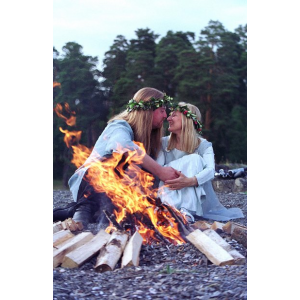
Collegiate Dictionary defines Kindred as: A group of related individuals; Of a similar nature and character; Of the same ancestry. I would agree with that definition, but it is only partly true. The Asatru Kindred is the foundation for the new Asatru Nation, and as such, is the testing ground for the new tribes of our Folk. In the near future, the Kindred will prove to be the living entity that will survive the onslaught of Ragnarok.
In ancient times, our people survived as an extended family. As populations grew, these extended families joined together to form tribes. This tribe was, in essence, a group of extended families. Over the years they developed their own unique traits, value systems, heritage, traditions, religion, and other vital characteristics. As time wore on, and the people grew larger in numbers, these tribes joined with others of similar character and formed Nations. Again, this method served the people for many years.
During the late Viking Age, and with the coming of Christianity, things changed. The Christian Church was only able to assert its authority over the people by either bribing certain leaders of the Nations with promises of unlimited power and authority with the promise of Kingship, or they obtained the same ends with the use of force and treachery. So, one by one, the Nations submitted to absolute control of the Church through the clever manipulation of Kings.
To further assert this absolute control over the people, countries were formed. These were nothing more than geographical areas defined by lines on a map. They were, in effect, the geographical areas where the new Kings could wield absolute control. Any farther than that was claimed by a neighboring Kingdom. Over time, this led to the formation of towns and cities of such size that large numbers of people were needed just to serve the infrastructure of the Kingdoms. People left the ancestral farmlands to live in the cities and serve the Kings and their armies. Once the Folk lost their natural bond with the land, they lost their souls, and the power and influence of the Kings and the Church was absolute.
The ties which bound the tribes together common ancestry, religion, heritage and social structures were meaningless in the towns and cities. All that mattered is that you swore allegiance to the King and the country which he led. It goes without saying, that the great fratricidal wars of Europe and America could not have been fought without this artificial form of political control wielded by the Church and State.
Today, as Asatru asserts itself, we must learn from the lessons of the past. And to regain our freedoms, we must work hard to rebuild our ancestral tribes. The Kindred is vital to our success and survival as an indigenous people.
Sadly enough, although Asatru at this time is experiencing tremendous growth, many who return to their ancestral religion don't wish to join or found Kindreds. They prefer to worship the Holy Aesir and Vanir alone, or occasionally with a few others of like mind. They do not want to be bothered with commitments, or they do not want anyone depending on them, or they just do not have time for working with others. This article is not for them. This article is for those who are endowed with the spirit of Tyr and are willing to devote their lives to building the Nation of Asatru and serving the Folk. Sacrifice is what makes you an Asatruar, not convenience.
I hope that this article has been of some help in explaining both what one should do to form a Kindred, but also how an existing Kindred can avoid some of the mistakes that the Founders made back in the days when forming a Kindred was breaking new ground with no one to look to for advice and instruction.
As the Asatru Community grows, and it is at a rapid rate, the Folk will look to the Kindreds to provide them with a place to be with people of like mind and purpose; a place for spiritual growth, and a place to share common social values.
It is up to us to prepare for the future by promoting the formation and growth of healthy and vibrant Kindreds, and thus secure a future for our children on Midgard.
In the development of Middle-Earth of the First Age, particularly in his treatment of the race of Men, Tolkien borrowed heavily from Scandinavian culture in the days of the Vikings. The Old Norse -- warriors who went "viking" -- were a violent and tribal people with little centralized power; the culture of Sigurd’s world is one of constant war between petty kings and marriage alliances between these tribal kingdoms. In Middle-Earth, the race of Men are divided into houses, notably the House of Hador and the House of Beor in the Turin tale, but they are also grouped together by the lands in which they dwell (the Men of Brethil, the Men of Dor-Lomin) and it is the race of Elves that have kings and cities, permanence and power. The Elves, although caught up in a time of war, have an established culture of peace that precedes Morgoth’s brutality; Men, on the other hand, came into the world after Morgoth had risen to power and thus, similar to the Vikings, their culture is one of constant warring, strife, and brutality.
Further minor Norse elements appear within this general culture. The concept of wergild, for example, is represented in T'urin's response to the accidental slaying of M'im the dwarf's son. "'I will pay you a danwedh of heavy gold for your son, in token of sorrow, even if it gladdens your heart no more,'" says T'urin to the bereaved dwarf. (H'urin, 132) And M'im, like Hreidmar, is satisfied with this payment.
Scenes of flyting, the ritual of insulting an opponent, aggravating him into a fury before battle, speckle the Eddas and sagas of the Old Norse. The dark, cruel humor of men about to kill each other is a trademark of Norse literature. The V"olsungasaga lacks extended scenes of flyting, but a prototype of the story in verse form found in the Elder Edda contains moments of flyting at its best (featuring Sinfjotli the berserker).Saeros' provocationis similar to the idea of flyting: Saeros, out of hatred for T'urin, heaps racial insults on him, mocks his appearance, and speaks contemptuously of the women of T'urin's people, angering T'urin into drawing his sword against him. This flyting, although the dialogue is one-sided, leads - like most flyting - to the mocker's humiliation and death.
He does so mainly through the influence of the Elves. They represent refinement, wisdom, artistry, and gentleness, and the difference Tolkien points out by contrasting the Easterlings with the House of Hador is that H'urin's people have had contact with Elves. All the great Men of Middle-Earth have contact with Elves in their formative years, including Beren, Aragron, H'urin, and T'urin, who was raised by Elves in Doriath; the Easterlings are an example of Men left to their own devices. Marjorie Burns, in her book Perilous Realms: Celtic and Norse in Tolkien's Middle-Earth, draws a connection between the Elves and the Celtic tradition, and from there links them to femininity and to Christianity; indeed, the effect that Elves have on Men is one of "Christianizing" them. The Children of H'urin stands out among other tales of the First Age as one dominated by Men, but the domestication of the Elves is still present, primarily through Beleg. Beleg comes after T'urin and enters the company of the outcasts, criminals, and vagabonds - Men much like the Easterlings, lawless, leaderless, and corrupt - and he gives them lembas, the life-giving bread of the Elves that is much like the bread of Communion, he tends their wounded, and he softens T'urin's proud, hard heart. With Beleg, T'urin leads his band of outlaws in battle against Morgoth's forces, turning them from selfish, ignoble behavior, robbing their own kind, to fight evil and protect their own kind.
Many arguments have been made for the prominence of women in Scandinavian literature and its implications for the role of women in Old Norse society. While calling the Vikings the first feminists may be exaggeration, it is undisputable that the female figure in the Norse world played a more active role than in parallel historical cultures. In the V"olsungasaga, Brynhild the Valkyrie, the warrior-woman whom Sigurd first finds clad in armor, is the driving force of the second section of the story, and Gudrun is the dominant character of the final chapters. In fact, the conniving and magical Grimhild, the fierce jealousy between Brynhild and Gudrun, and the ruthlessness of Signy as a mother make the women of the V"olsungasaga both stronger and more compelling than their male counterparts.
Tolkien is notorious for including few or no women in his tales – there is no mention of a female character anywhere in The Hobbit, and of the five women given any space in The Lord of the Rings (including Ioreth, the bustling healer), only one – Eowyn – plays a part in the main events. But in The Children of Hurin, female characters abound. Finduilas, Morwen, and Nienor play lead roles, but there are others, including Nellas, Melian, and Aerin, the abused wife of Brodda the Easterling. They do not have the same dramatic power as the women in the Volsungasaga – there is no Eowyn, no Valkyrie, no idealized Viking-woman here – and yet their presence is keen and their effects on the male figures of the story are apparent. Melian seems wiser than Thingol on every occasion, Nellas’ testimony redeems Turin, and Turin’s complex relationship with every woman he encounters, hinging on his childhood losses of both mother and beloved, infant sister, is a key element in his psychological makeup.
Labels: druid gods and goddesses all of the gods and goddesses list of all greek gods and goddesses celtic gods and goddesses black magic rituals book protection spell wicca wiccan book of shadows yule log
Rune Mysteries Minnesota
As you go across the width and breadth of this land, you will find Viking artifacts, Indian Legends and Rune Mysteries that truely tell us that the Vikings were in America prior to the Eleventh Century.
There is the story (how ever I cannot prove it) that the Smithsonian, took shiploads of Artifacts and dumped them into the ocean! Why would they do this? Because it was easier to do this than rewrite history.
One of the most controversial finding was Olaf Ohman's "Kensington Runestone."
The Smithsonian and academia skoffs at the find saying Ohman carved the Runes into the Stone himself.
Robert A. Hall wrote the book called "The Kensington Rune-Stone, Authentic and Important."
The words and Runic Characters were traced back to the 14th Century Sweden. Most of the words are not used any more.
How could Ohman, who was functionally illiterate, carve the stone using those out dated words?
Viking research at the site is still at a standstill, despite all the supporting evidence of numerous Axes and Spears.
In Artichoke Lake, Minnesota, infrared aerial photography reveals nine Viking habitation sites, plus three Viking type vessels submerged in the lake. No archaeologist from the establishment will check this out.
Brown's Valley and Sank Center have similar sites.
The following is a translation of the Kensington Runestone Goths and 22 Norwegians on this discovery voyage from Vinland over the wes we had camp by 2 Skarries one days journey North form this stone we were and fished one day after we came home found 10 men red with blood and dead Preserve form evil have 10 men by to see after our ships 14 days journeys from this island year 1362." You can find a great deal more information about the "Kensington Rune Stone" of Minnesota."
by Ragnar Storyteller
Ellis Peterson AKA Ragnar Storyteller is a retired math professor and electronics engineer. He has been studying astrology, runes, radionics, metaphysics and alternate healing treatments for over 30 years. He is 70+, in very good health and lives in the boonies of the Pocono mountains with his wife Lory. His writings are unique and refreshing.
To see more of his writings visit his websites.
http://www.olevikingshop.com/
http://www.runes-for-health-wealth-love-now.com/
http://www.radionics-quantum-physics.com/
Or go to goggle and type in his pen name RAGNAR STORYTELLER for his listings. He is also a ghost writer and will write and article for you. Email Ragnar for his FREE 10 PART MINI-COURSE, "How-To use Quantum Physics in Your Every Day Life to Attract More Wealth, Health and Love, Now."
You can contact him at: ragnarstoryteller2@gmail.com
Labels: roman gods and goddesses myths gods and goddesses viking god thor gods and goddesses of mythology egyptian gods and goddesses list of pagan gods and goddesses wiccan spells love voodoo love spells free black magic spells books how to do voodoo love spells
RUNE-POWER
You must understand what Rune Power is:
Runes are universal creative energies. Each rune is a key to a creative energy energy. Example: Rune FA = wealth, Rune Ur = Health, Rune Thorn = protection, etc.
The new Laws of Quantum Physics tell us that there exists an infinite ocean of thinking, intelligent energy called the Quantum Ocean where everything that ever was, is or will be exists.
The Runes and the gods/goddesses of the North exist there and have alwaus existed tehre.
We can contact and transfer the energies of the Quantum ocean with our thoughts, symbols and rituals. We can have Odin present in our meetings for Wisdom. Let Thor and his mighty hammer walk along side you and your family when out shopping or at work. Keeo muggers and evil doers away.
The purpose of the 21st century, Age of Aquarius Rune Shaman, Rune Wizard and Rune Sorcerer is to go to the Quantum Ocean and bring the energies of the Runes and the gods/goddesses into the now. Bring their energies and power into the present. Do not go back and live in the past with them. Walk and talk with the gods/goddesses now.
Now you as a Rune Shaman, Wizard, Sorcerer can use your mind to bring the energies of the runes and god/goddessess of the North out of the Quantum Ocean and create new structures, new ritual for them. Modern day structures and rituals. (see my other webpages).
Mentally contact the viking helpers you need, both physical and non-physical to aid you. Use your mind to continue the battle for the freedom of our Ancestral Soul and our Culture. The fight needs to be taken to the mental plane. It is here where we can win.
We can do this together. We can revitalize the enrgies of the Runes and our Northern European Culture.Bringing the power of the past into the now.
Email me for my free Rune Power Newsletter.
by Ragnar Storyteller
Ragnar Storyteller (AKA Ellis Peterson is a Korean War Vet living with his wife Lory and dog Dixie in the boonies of the Pocono Mountains. He is a retired math professor and electronics engineer. He is the inventor of the simple radionics device called "The Nordic Ond Orgone Generator." He has written over 200 articles. See them on his websites: http://www.olevikingshop.com/ and http://www.Spiritual-Quantum-Physics.builderspot.com/
Labels: gods and goddesses images mythical greek gods and goddesses anglo saxon hero greek gods and goddesses outfits all gods and goddesses of greek mythology astral projection courses find love spell voodo love spell astral projection for beginners
Sweetie and I had a quiet private Winter Solstice celebration on Monday night. We managed to wait to break into the stockings and gifts until after the sun had set. I lit the magic candles on the tree and sitting on the floor by the tree we pulled treasures from our stockings and then handed each other presents from family, loved ones, and ourselves. Moj got an antique Dionysian pitcher and plate for ritual cakes and wine, Dionysus oil and incense, as well as many witchy books, more incense, candy, and homemade preserves. I received a ton of witchy books (love my witchy man!), chocolate, an evil eye doll from Toadbone's Apotheca, pairs of beautiful handknit socks from my Mom, books from her trip to Scotland, handmade soap, and also some powders and animal curios for magic. For both of us I had purchased an authentic set of Welsh horse brasses as a house protection and blessing charm. Most horse brasses are just for show - this one was made from an actual well-used thick piece of saddle with a lovely pattern stitched into it. The leather is so old it is starting to decay and a few of the leather strips holding on the brasses had broken so I had to repair them. The symbols on the brasses are personal to us, so I just showed a few in the picture.
In honour of the occassion I set to work after presents preparing the Yule feast we'd share with the God. First I started the wassail by adding a bottle of last year's apple mead, apple juice, lemons stuck with cloves, sliced apple, cinnamon, and nutmeg into my crock pot to warm while cooking dinner. My apple mead turned out tasting a bit like sherry and a pretty red colour - strange but delicious! I made a wintry feast of pork schnitzel with maple syrup-roasted root veggies (beets, carrots, parsnips, and maple syrup my Dad harvested on his farm last February), mashed Yukon Gold potatoes, and some homemade gravy to pour over half of it. We put a bowl of the wintry feast on the God's altar and left him some wine and then went off to watch Terry Pratchett's Hogfather while eating our own plates of the feast.
Labels: books on greek gods and goddesses egyptian gods and goddesses pictures norse god egyptian gods and goddesses pictures ancient rome religion norse gods and goddesses belief was christian dear ones service writer seeks dna
Nordic Paganism is a Reconstructionist form of Paganism. The primary source materials are literary texts written in medieval Iceland in the historical range of 1100 to 1300, in the Germanic-Scandinavian language variously known as Old Norse or Old Icelandic, which is indeed quite similar to modern Icelandic. These texts are believed by modern Nordic Pagans to preserve Pagan beliefs from long before Iceland’s conversion from Norse Paganism to Christianity in the year 1000, an event that will be discussed in a later section. Several categories of texts are important to modern Nordic Pagans. First, there is the collection of largely mythological poems known as the Poetic Edda, with individual Eddic poems providing accounts of the past creation and future destruction of the world, the nature of the Norse universe, and the adventures and misadventures of the various gods, as well as the exploits of certain nondivine heroes and heroines. Further information on the same topics is given in a supplementary text, the Prose Edda, written by the medieval Icelandic scholar and statesman Snorri Sturluson.
The leader of the Norse gods is Odin, the one-eyed god of wisdom, war, magic, and poetry, among other powers and functions. Other prominent Norse deities include Thor, the reliable protector of humankind who brandishes a hammer to smash malevolent giants and other foes; Tyr, god of war and oaths; Frigg, the wise wife of Odin; Baldur, the son of Odin, fated to first be slain by his own brother and then return from death to rule the world; Loki, the sometimes harmful, sometimes helpful god of guile and trickery; AEgir and Ran, god and goddess of the sea; Freyja, the goddess of fertility, love, and war; her twin brother Freyr, also associated with fertility; Njorthur, god of seafaring, fishing, and commerce and father of Freyja and Freyr; and Hel, the goddess of death. Other deities are described in less detail in the Old Norse literature, and other classes of supernatural beings such as Elves and Landspirits, worshipped in both ancient Norse tradition and modern Nordic Paganism.
Labels: pictures of egyptian gods and goddesses death of balder athens gods roman gods and goddesses list gods and goddesses of egypt all greek gods and goddesses heaven and hell lucid dreaming book anglo saxon heathen god